Voice UX
By Mark Cohen
Years ago in another life, we were building skills for Alexa. It was early days for voice interfaces, and we learned something counterintuitive fast: the hard part wasn't the technology. It was the conversation itself.
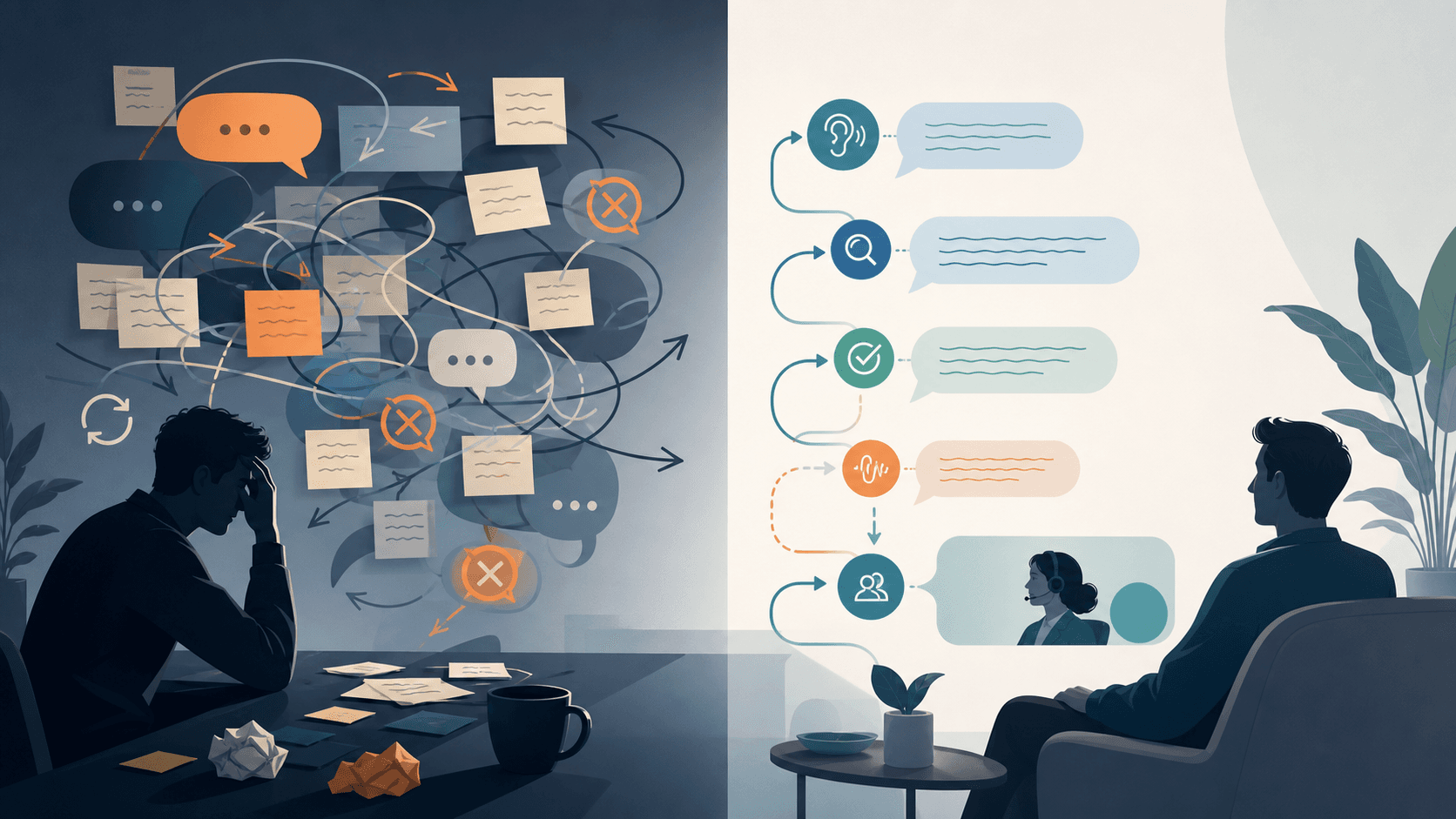
We had a UX designer who self-trained specifically in voice UX. Her job was to map how a dialogue should unfold. When to ask a question, when to confirm, when to stay quiet, when to hand off to a person. That discipline barely existed in most teams at the time. We needed it anyway, because the alternative was a voice assistant that technically worked but felt broken to talk to.
I'm seeing the same problem resurface at scale now, in particular as we pursue AI voice agents. When they behave awkwardly, a PM's first instinct is to patch the prompt. Add an instruction. Block a failure mode. A different issue inevitably shows up the following week, because they are at heart non-deterministic.
This isn't a prompt problem. It's the same interaction design problem we solved on Alexa, just wearing a new engine. the new prompt-driven interfaces make it harder to engineer the voice UX but its also more important than ever to keep working on it.
Conversation has a natural / expected structure. It needs rules for pacing, confirmation, interruption handling, and escalation to a human. Those choices shouldn't be a second thought, buried inside a massive and growing prompt set. They need people who treat dialogue as a designed system, the way voice UX specialists did a decade ago.
Language models generate fluent words. They don't generate a coherent conversation on their own. The skillset that mattered in the Alexa era matters again now, and many teams building conversational AI haven't rebuilt it yet.
#ConversationalAI #VoiceUX #ProductDevelopment #AIAgents